AFTER SKETCHES
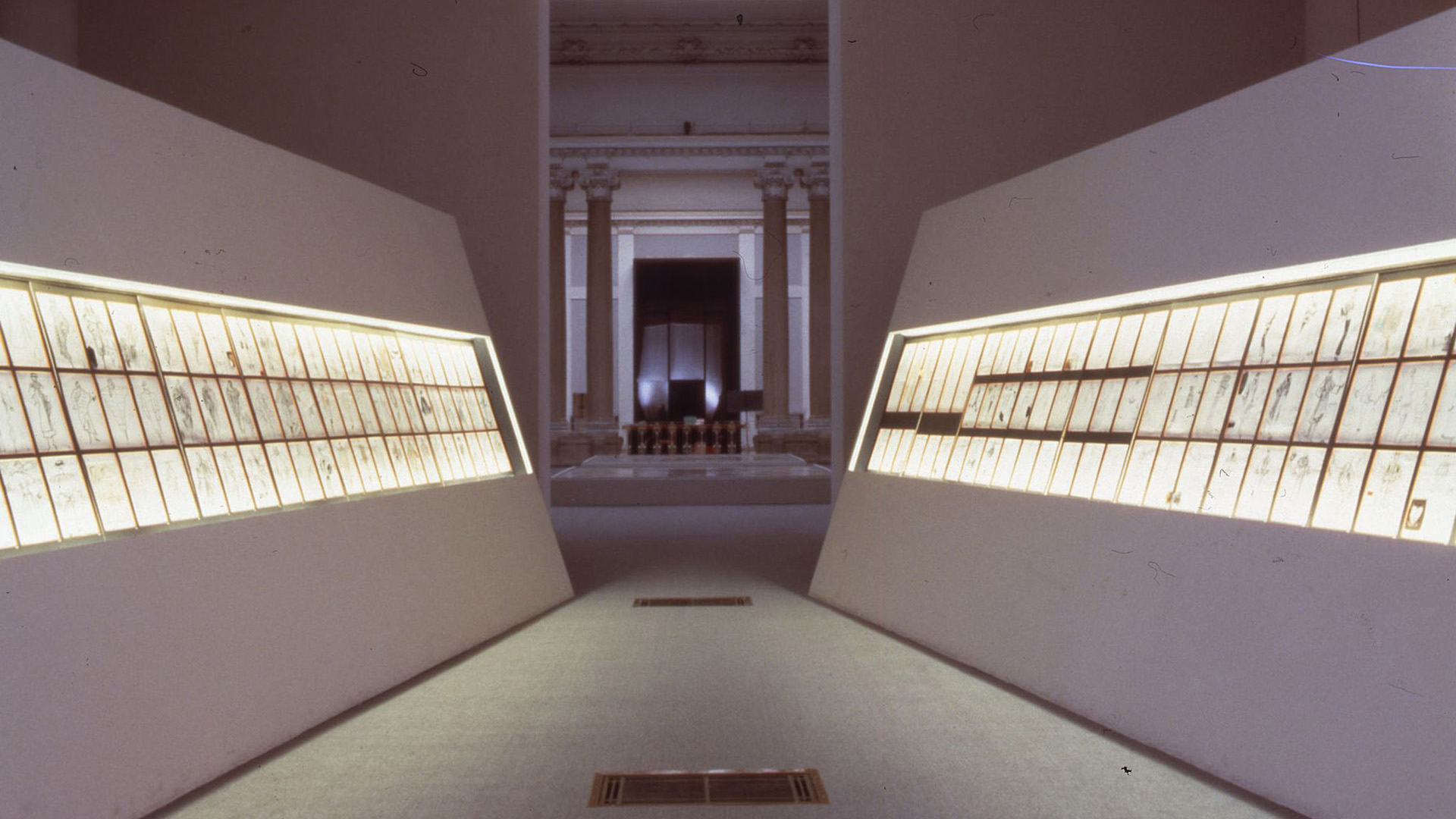
Restaging the 1985 exhibition in different areas of the museum required a reconfiguration of the section devoted to Karl Lagerfeld’s sketches. Lagerfeld drew constantly. For him, drawing was a way of thinking – a means of immediately clarifying what he was imagining. Once the initial sketch evolved into a drawing, it was refined down to the finest detail, so that it could be understood by all those who would, at various stages, transform it into wearable architecture
The number of sheets has been reduced to one hundred and sixty-four, which remains a substantial number and testifies to the quality of Lagerfeld's draftsmanship and his inexhaustible imagination, always tempered by a practical design sensibility. Many of the drawings now appear at a different scale, having been mounted on individual supports. The accompanying annotations and explanations testify to their vitality and significance
The relocation of the drawings to the two corridors flanking the central hall has made it impossible to preserve the telescopic perspective of the original installation. At the same time, however, it invites visitors to see the sketches anew, highlighting their value as works in their own right, and confirming their creator's place in the history of contemporary fashion
(2026)
Visible from the entrance, the gallery presents a long telescopic sequence of sketches selected from the approximately 2,000 drawings produced by K.L. during his twenty-year collaboration with Fendi. These drawings speak for themselves. Year after year, Lagerfeld’s line transforms, from the almost naturalistic, yet wry and understated mark of 1966—when fur was already colored and conceived as modern mountain outerwear—to the gritty, almost expressionistic line of the sketches produced in his later years. The most decisive shift appears to occur around 1975, when K.L.’s approach to drawing changes almost radically. Increasing emphasis is placed on the shoulders, faces become more angular and expressive, and a marker pen begins to trace the outlines. Yet certain motifs recur throughout the twenty-year period: The equestrian (1966, 1970, 1979), the redingote in its many variations, the bodysuit and the gilet. Other ideas are hinted at in one season, only to be developed and refined in the following season (asymmetry appears in 1982 and is expanded upon in 1983, the tunic makes its first appearance in 1983 and is further developed in 1984, and the belted silhouette creating an hourglass figure is introduced in 1981, only to be revisited and reinterpreted in 1984 and 1985)
(1985)